

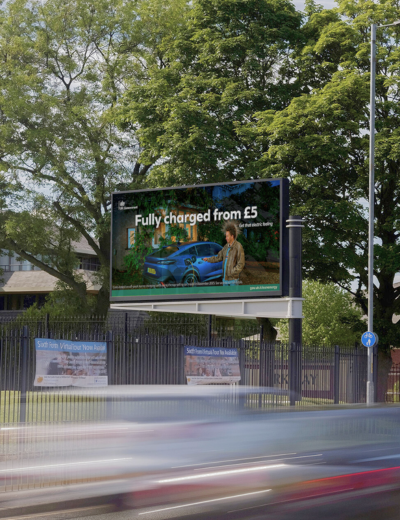

To accelerate electric vehicle adoption, the UK Department for Energy Security and Net Zero (DESNZ) and the Department for Transport (DfT), through Crown Commercial Service (now Government Commercial Agency), launched a roadside programmatic Digital Out-of-Home (pDOOH) campaign with a twist: it only ran when the grid was clean.
Across 40 premium JCDecaux roadside screens in cities including Birmingham, Manchester and Liverpool, delivery was governed by live carbon-intensity data. The result is the first carbon-aware pDOOH campaign to cut emissions at source, proving that media planning itself can be a tool for decarbonisation.
The challenge: a sustainability message that had to practise what it preached
The UK Government has ambitious Net Zero targets for electric vehicles (EV) adoption. Yet many drivers still saw electric vehicles as a future choice rather than a current one. Through its Clean Energy Mission, DESNZ and DfT set out to raise awareness of the practical, financial and environmental benefits of switching.
Roadside DOOH was the natural channel: it reaches people at the very moment they are thinking about transport. But it raised a dilemma. Standard DOOH runs continuously and consumes electricity every hour it is on screen. A campaign encouraging cleaner transport could end up generating avoidable emissions, weakening its own message.
If drivers were being asked to make more sustainable choices, the media had to do the same.
The strategy: carbon as a planning variable, not a reporting metric
Instead of measuring carbon after the fact, the campaign built it into the buying decision. Alongside Flux, Displayce integrated a live carbon-intensity feed into the media platform’s decision rules, using real-time data from the National Energy System Operator (NESO).
The logic was simple and strict:
- Below an agreed seasonal threshold, the campaign activated.
- Above it, delivery paused automatically, even during periods of high audience demand.
Crucially, the data was granular. Carbon intensity was tracked across the UK’s 14 regional energy networks, so each screen responded to its own local grid. For the first time, campaign delivery was governed by environmental conditions as well as audience opportunity.
Three principles shaped the activation:
- Conditional, not continuous: the campaign only appeared when environmental conditions supported it.
- National consistency, local responsiveness: one campaign that behaved differently depending on local grid conditions.
- Proof, not promise: emissions were cut by changing delivery, not by offsetting.
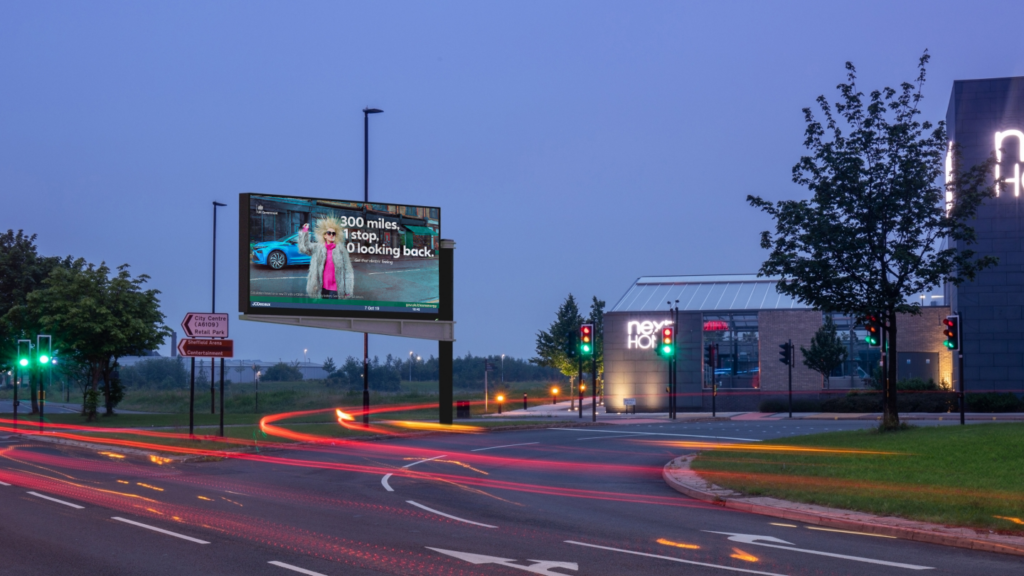
The campaign ran programmatically through VIOOH on JCDecaux UK’s premium roadside inventory, with media planning by OmniGOV @ MG OMD and Posterscope.
The creative: complex technology, simple message
Rather than a static set of executions, the team built six creative variants linked to the live feed. Each activated only when local grid conditions met the low-carbon threshold. For drivers, the experience stayed deliberately simple: clear, government-branded messages on the benefits of switching to an EV.
Campaign results: lower carbon, no trade-off in impact
The campaign proved that brands and institutions do not have to choose between carbon reduction and effective media.
By changing when the media ran, rather than where or how often, the campaign cut its carbon intensity by 86% compared with a standard DOOH approach, without compromising impact. A brand lift study confirmed the message landed: the share of drivers who would consider an EV for their next vehicle rose by +7 points, and almost a third of those who recognised the campaign reported taking direct action.
Key results:
- 40 premium digital roadside screens deployed.
- 534K+ plays, all triggered during low-carbon periods.
- 5.5M+ impressions delivered.
- 86% lower carbon intensity vs. standard DOOH.
- +7 points in EV consideration.
When sustainability shapes how media is delivered
By treating environmental data as a core planning variable alongside audience data, DESNZ and DfT proved that pDOOH can reduce its footprint at source while still shifting understanding and behaviour at scale.
For organisations serious about sustainability, it should not stop at the message. It should shape the way communications are delivered too.

